Jun 2025 – Bioenergy is crucial for Europe’s ability to reach its climate targets a study shows. A recent analysis, led by Chalmers University of Technology in Sweden, indicates that the transition to a net-zero or net-negative European energy system will be difficult and costly unless the EU invests in biomass. Additional info available here.
Mar 2025 – Synergies for bioenergy supply chains in bioeconomy networks. The report “Synergies for bioenergy supply chains in bioeconomy networks” presents a framework for shifting from linear value chains to integrated bioeconomy networks, enabling synergies that enhance resilience, efficiency, and collaboration across bioenergy and biobased systems. Available here.
Feb 2025 – Robustness of GHG emission verification and certification of biofuels – a case study of selected (SAF) supply chains and policies. The report analyses international SAF policy frameworks, highlighting key challenges in GHG verification and certification, and offers recommendations for greater harmonization, transparency, and robustness across supply chains. Available here.
Jan 2025 – The role of bioenergy in the energy transition, and implications on the global use of biomass. The commentary outlines how biomass can contribute to the IEA Net Zero Emissions by 2050 roadmap through sustainable sourcing, sector-specific applications, and biogenic carbon management, highlighting its roles in energy supply, industry, transport, and negative emissions. Available here.
Jan 2025 – Bioenergy, the carbon cycle and climate change mitigation. The factsheet explains how sustainably managed bioenergy can displace fossil fuels and support climate goals, while highlighting the importance of evaluating the full carbon cycle to avoid risks and maximize benefits. Available here.
Dec 2024 – Factsheet: what is bioenergy? New factsheet on bioenergy published here.
Sep 2024 – IEA: Carbon accounting is of increasing importance in biofuel policies around the world. The report highlights the need for transparent, science-based and internationally aligned carbon accounting to ensure credible GHG performance, guide effective policy, and unlock investment for scaling up sustainable biofuels. Available here.
Feb 2024 – Environmental sustainability studies of biohub archetypes. The report assesses three biohub models in Europe, showing that mobilizing agricultural and forest residues through biohubs can achieve significant GHG reductions -over 90% in some cases- making them key enablers for cost-effective decarbonisation of heat and transport. Available here.
Feb 2024 – Evaluating metrics for quantifying the climate-change effects of land-based carbon fluxes. The paper evaluates 15 metrics for assessing GHG impacts, finding the Climate-Change Impact Potential (CCIP) most suitable, and highlighting how metric choice strongly influences policy and LCA outcomes for bioenergy and land-use strategies. Additional info here.
Nov 2023 – Assessment of successes and lessons learned for biofuels deployment. The IEA Bioenergy project “Lessons learned biofuels” (2020–2023) synthesizes insights from past biofuel development cycles, highlighting the need for combined market-pull and technology-push policies, continuous learning, and both improvement of existing biofuels and support for innovative solutions to advance sustainable transport decarbonisation. Additional info here.
Aug 2023 – Assessment of successes and lessons learned for biofuels deployment – Meta-analysis of existing studies. Meta-analysis of advanced and conventional biofuel projects identified key success factors, including supportive policies, feedstock management, technology readiness, and environmental and social indicators; challenges remain with feedstock availability, legal restrictions, and economic fluctuations, highlighting lessons for replicating projects and developing novel biofuels. Additional info here.
Jun 2023 – Towards an improved assessment of indirect land-use change – Evaluating common narratives, approaches, and tools. IEA Bioenergy Tasks 43 and 45 reviewed methods to assess indirect effects of biofuel production in the U.S. and Brazil, finding two narratives give divergent results and evidence questions key causal assumptions. Additional info here.
October 2023 – Bioenergy in a Net Zero Future -Summary and conclusions from the IEA Bioenergy Workshop. Download summary here.
Mar 2023 – BECCUS value chains – from concept to commercialization. IEA Bioenergy project across Tasks 36, 40, 44, and 45 analyzed opportunities and obstacles for deploying bioenergy with carbon capture and utilization or storage (BECCUS), highlighting mature CO2 capture technologies, R&D needs for business models, industry- and country-specific deployment conditions, and policy design challenges, with further research planned for 2022–2024. Additional info here.
Dec 2022 – Environmental impacts of perennial grasses on abandoned cropland in Europe. A study in Environmental Impact Assessment Review shows that cultivating miscanthus, switchgrass, and reed canary grass on abandoned European cropland can deliver 1–7 EJ/year of bioenergy, improve soil carbon stocks, reduce GHG emissions, and contribute to negative emissions while providing energy and material feedstocks. Additional info here.
Dec 2022 – Widespread deployment of grass in crop rotations. A study in GCB Bioenergy shows that integrating grass into crop rotations across Europe can provide biomass for biogas and protein, enhance soil carbon sequestration, reduce nitrogen emissions and erosion, and deliver 13–48% of agriculture GHG mitigation, with additional co-benefits for yields and biodiversity. Additional info here.
Oct 2022 – Supply potential of lignocellulosic energy crops on marginal land in the EU. A study in GCB-Bioenergy quantifies EU marginal land availability and biomass potential, showing that lignocellulosic crops can produce up to 2.26 EJ/year of advanced biofuels by 2050 with variable GHG performance, emphasizing location, crop choice, and supply chain design to maximize climate benefits. Additional info here.
Jul 2022 – Co-recycling of natural and synthetic carbon materials. A study in Science Direct shows that integrating biological and technical cycles via thermochemical co-recycling can reduce fossil carbon use, avoid emissions, and enable near-zero carbon material systems, supporting circular economy and climate goals. Additional info here.
Jul 2022 – LCA and negative emission potential of retrofitted cement plants. A study in Scientific Reports shows that retrofitting cement plants with oxyfuel carbon capture and using high shares of biogenic fuels can reduce emissions by 74–91% and achieve negative emissions, highlighting large climate mitigation potential with some trade-offs in other environmental impacts. Additional info here.
Jun 2022 – Carbon accounting in Bio-CCUS supply chains. An IEA Bioenergy report highlights key scientific and policy challenges in quantifying climate impacts of Bio-CCUS systems, emphasizing differences between Bio-CCS (negative emissions) and Bio-CCU (variable CO2 storage), and the need for robust accounting frameworks to guide policy and deployment. Additional info here.
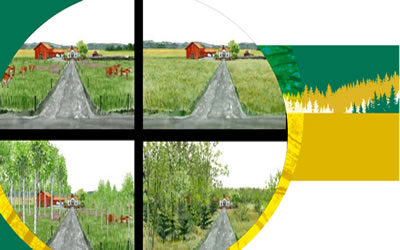
Jun 2022 – More biomass and less negative environmental impact. Research by IEA Bioenergy Task 45 and Swedish partners shows that multifunctional perennial cropping systems can increase biomass production while reducing negative environmental impacts like nitrogen leakage, soil erosion, and flood risks across European landscapes. Additional info here.
May 2022 – WS27: Bioenergy and Sustainable Development – Climate change mitigation and co-benefits. A workshop by IEA Bioenergy, GBEP, and Biofuture Platform highlighted bioenergy’s role in climate mitigation, CDR through BECCS, sustainable land and forest management, ecosystem and socio-economic co-benefits, trade-offs with food and biodiversity, and the importance of good governance and policy for modern bioenergy deployment. Additional info here.
May 2022 – Land use for bioenergy: synergies and trade-offs between SDGs. A study in Renewable and Sustainable Energy Reviews shows that dedicated energy crops can create both synergies and trade-offs with SDGs depending on context-specific factors such as previous land use, feedstock type, climate, soil, and management, with marginal land and perennial crops helping to minimize trade-offs. Additional info here.
Mar 2022 – Webinar on quantifying climate effects of bioenergy. An IEA Bioenergy Task 45 webinar introduced methods and tools to assess GHG emissions from bioenergy, covering reasons for contrasting findings on forest bioenergy, comparisons of calculation tools, and illustrative examples to guide stakeholders. Additional info here.
Oct 2021 – Biomass supply chains and the SDGs. An IEA Bioenergy report presents 37 case studies from 18 countries showing how biomass supply chains (forest, residues, energy crops, waste) contribute to sustainable bioenergy while supporting multiple SDGs. Beyond SDG 7, many cases also advance SDGs on economic growth, industry, resource efficiency, climate, land, farming, and equity. Additional info here.
Sep 2021 – Strategic deployment of riparian buffers and windbreaks in Europe. A study in Communications Earth & Environment shows that introducing perennial crops as riparian buffers and windbreaks can deliver both biomass and environmental benefits. Large-scale deployment across Europe could reduce nitrogen emissions, soil loss, and flooding risks while maintaining agricultural productivity, supporting CAP objectives and the bioeconomy. Additional info here.
May 2021 – Deployment of bio-CCS: case studies. The IEA Bioenergy project “Deployment of Bio-CCS/CCU Value Chains” presents case studies on integrating CCS in biomass-based energy systems, including HOFOR (Denmark), Drax (UK), and Fortum Oslo Varme (Norway). Results highlight technological readiness, but stress the need for supportive policies, business models, and infrastructure to enable large-scale deployment of negative emissions. Additional info here.
Feb 2021 – Campaigns questioning woody biomass for energy. Media campaigns often misrepresent woody biomass as “burning trees”, ignoring sustainable forestry practices and safeguards. Most bioenergy feedstock comes from residues and low-quality wood, making it an important renewable energy source that supports carbon neutrality when managed responsibly. Additional info here.
Jan 2020 – New Publication – Roles of bioenergy in energy system pathways towards a “well-below-2-degrees-Celsius (WB2)” world. The IEA Bioenergy Inter-task project “The Role of Bioenergy in a WB2/SDG world” held a workshop in Berlin (25 November 2019) to assess how bioenergy can support WB2 targets. The report highlights the central role of bioenergy with CCS, the need for expanded biomass supply and infrastructure, country-specific strategies, integrated land-use planning, and strong governance to align bioenergy deployment with climate and SDG goals. Additional info here.